

When does protest become terrorism?
How the UK is changing the rules on petty crime to attack free speech.

One man’s terrorist is another man’s freedom fighter
These are the words of Gerald Seymour, from his 1975 novel Harry’s Game — words which ring truer than ever in the current political climate. Nowhere is that more accurate than on an RAF runway in Oxfordshire, where in June 2025 a group of activists broke into RAF Brize Norton and sprayed red paint across two military aircraft. Within weeks, the group behind it — Palestine Action — has been likened to Al-Qaeda, ISIS, and neo-nazi terror groups.
The question of whether that was a proportionate response to criminal damage is now before the UK’s highest court — the Supreme Court of the United Kingdom.
Since I last wrote about this topic, there have been significant developments. This ranges from the courts to the arrest figures.
A recap
If you are unaware, or have not read the prior piece on this, Palestine Action was founded in 2020 as a direct-action campaign targeting arms manufacturers and other companies it accuses of supplying or supporting Israel’s military. Its methods — occupations, break-ins, spray-painting, peaceful protest, and property damage — sit at the more controversial and confrontational end of protest tactics.
For five years they were treated — and largely prosecuted — as ordinary criminal offences, such as criminal damage, aggravated trespass, and the like.
However, everything changed after 23 June 2025, when activists broke into RAF Brize Norton and damaged two military aircraft. A video from The Times News (The Sunday Times) is provided to show the damage:
Then-Home Secretary Yvette Cooper described it as the latest in what she called a “long history of unacceptable criminal damage” by the group, and on 2 July 2025, with 385 to 26 votes in favour, she told the House of Commons she had decided to proscribe Palestine Action under section 3 of the Terrorism Act 2000.
The ramifications were felt immediately, as membership of Palestine Action, inviting support for it, or expressing an opinion or belief that is in support of the organisation, became a terrorism offence carrying a maximum sentence of fourteen years’ imprisonment — the same legal footing as supporters of ISIS, the Wagner Group and Al-Qaeda.
A year later, over 3,000 arrests have been made against protestors supporting the group, with over 700 charged.
Now, you may wonder, “What counts as inviting support, or expressing an opinion that is in support?”…
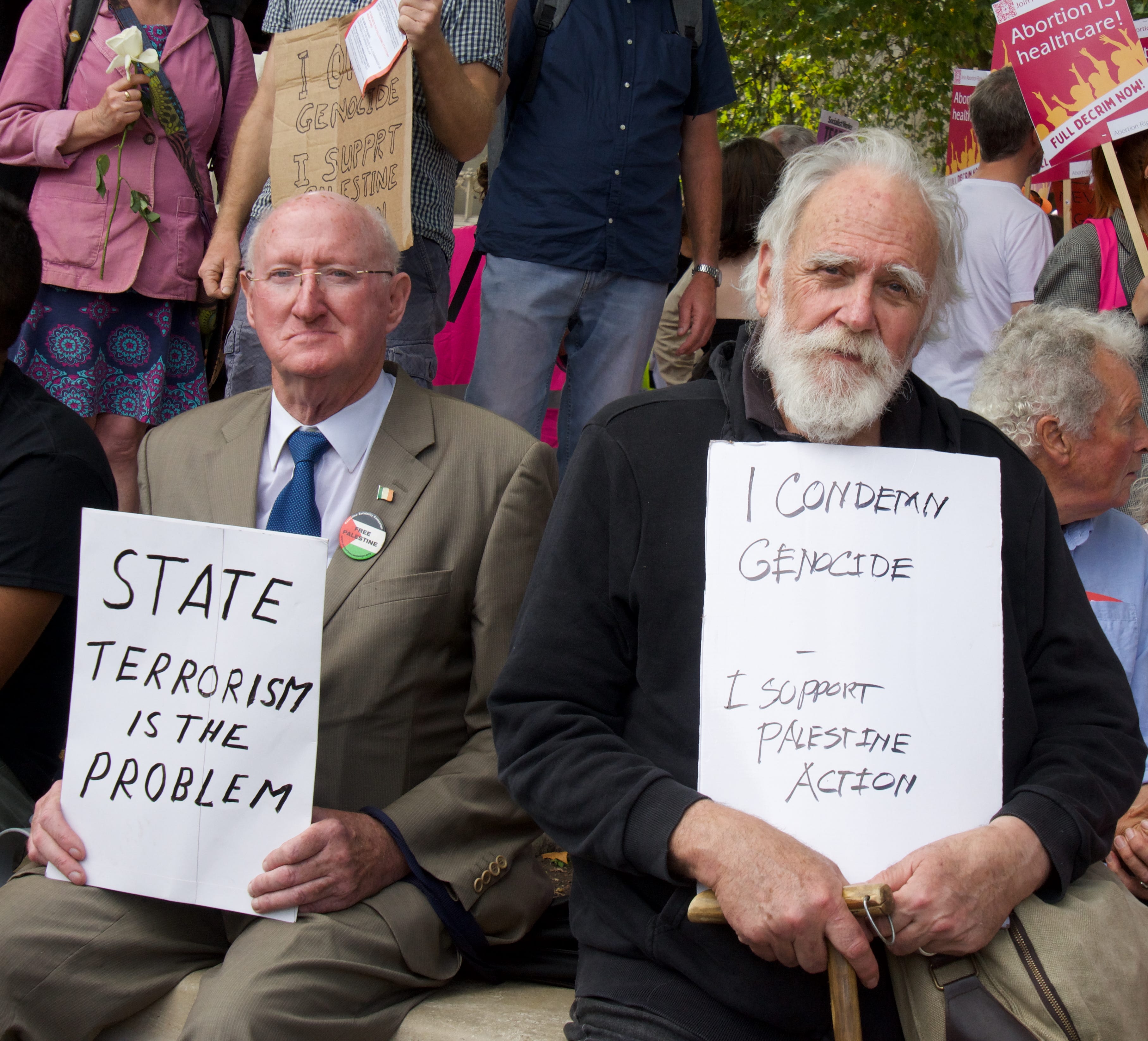
Well, we have seen a large majority of these arrests coming from those protesting against the ban, for simply holding signs saying “I condemn genocide — I support Palestine Action” and “We are all Palestine Action”.

What makes something “terrorism”?
To understand why this case matters beyond one protest group, it helps to look at the statute itself. Section 1 of the Terrorism Act 2000 defines terrorism as the use or threat of action, through numerous cumulative elements:
Where the action involves serious violence against a person, serious property damage, endangers a person’s life, or creates a serious risk to the health or safety of the public, or is designed to interfere with or seriously disrupt an electronic system.
The use or threat is designed to influence the government [or international government organisation] or to intimidate the public or a section of the public, and
the use or threat is made for the purpose of advancing a political, religious, [racial] or ideological cause.
Section 3 then gives the Home Secretary the power to proscribe any organisation they reasonably believe to be “concerned with terrorism” (s.3(4)) as defined above.
The most crucial point is that the statute’s first limb includes serious damage to property alongside serious violence against an individual. Yet it doesn’t require one to endanger or threaten another’s life to be labelled a terrorist.
That vagueness is deliberate, as Parliament wanted the definition to be wide enough to capture emerging threats. But it also means that, read literally, a protest group that commits large amounts of vandalism can now be captured under the same law used against groups like the IRA or ISIS.
Whether it should be is exactly what the courts have now been asked three times to decide.
Three courts, three answers
The Divisional Court (13 February 2026): Palestine Action co-founder Huda Ammori brought a judicial review challenging the proscription, with Liberty and Amnesty International UK intervening in support. The Divisional Court ruled that the proscription was an unlawful interference with the rights to freedom of expression and freedom of assembly and association under Articles 10 and 11 of the European Convention on Human Rights (ECHR), which was codified through the Human Rights Act 1998.
Central to its reasoning was a proportionality point, noting the hundreds of actions attributed to Palestine Action over its history; only a handful were found to meet the statutory threshold for terrorism, and ordinary criminal law was available to deal with the rest. Therefore, the court held the ban should be quashed.
The Court of Appeal (15 June 2026): The government appealed, and a five-judge panel, including the Lady Chief Justice and Master of the Rolls — the two most senior judges in England and Wales — overturned the Divisional Court’s decision. It found that the Home Secretary was entitled to significant deference on matters of national security, citing numerous cases, such as R (Lord Carlile) v Home Secretary [2014] UKSC 60.
In their own words (paragraph 175), it was a “justified and proportionate interference with ECHR rights”. The court characterised Palestine Action not as a straightforward civil disobedience movement, but as an organisation that promoted unlawful violence and encouraged the destruction of property, in an “escalating campaign”.
The Supreme Court (permission granted 30 July 2026): Three justices — Lord Sales, Lord Laggatt and Lady Simler — permitted Ammori to appeal, but only on one out of two grounds. The two grounds were:
(i) the Home Secretary’s reasoning in support of the decision was inconsistent with her policy; and
(ii) proscription was incompatible with articles 10 and 11 of the ECHR.
The court found that the proscription falls within the ambit of the exceptions carved out in the ECHR, meaning the appeal is only allowed based on the inconsistency with the Home Secretary’s policy.
The case has been expedited for hearing during the Michaelmas term (October to December 2026). In the meantime, related criminal cases have been adjourned until 26 October, to await the result.
Case for concern
For civil liberties organisations, the worry here is not just about Palestine Action as it’s actually about the precedent this sets. Historically, UK terrorism convictions have been confined almost entirely to groups overtly connected to organised violence.
Palestine Action is the first primarily property-damage-based protest movement to be proscribed under the Act. If a “serious damage to property” limb on its own is sufficient — without ever using or threatening violence against a person (other than the odd individual) — then in principle, almost any sufficiently disruptive and well-organised action campaign, on any cause, could meet this statutory bar depending on who holds a majority in Parliament.
If you look at groups like Greenpeace, they have done near-identical actions, such as painting an oil industry ship with “THEY PROFIT, WE PAY”. Additionally, Extinction Rebellion activists smashed the windows of the British bank, ‘Hongkong and Shanghai Banking Corporation (HSBC)’ — causing £500,000 (~$675,000) in damage — but were acquitted of criminal damage.
When you apply the definition of terrorism, one can argue that these environmentalist groups are causing significant property damage, which is intended to threaten the government and the public, and is to further a political cause. I urge you to look at the absolute absurdity of this policy and to consider if saying ‘I support Palestine Action, I oppose genocide’ should be treated more severely than a group destroying banks’ windows, blocking highways, or vandalising commercial vessels.
Why is it one rule for one group, and a completely different set for another?
This all has a domino effect well beyond Palestine Action’s own membership. Because expressing “support” for a prescribed organisation is itself a criminal offence, people who have never engaged in property damage or “terrorism”, and who may only support the group’s stated aim of ending arms sales to a conflict zone, have found themselves facing up to 14 years’ imprisonment.
Liberty and Amnesty have argued that this produces a chilling effect on protest and political speech that goes well beyond the specific incidents that triggered the ban — and the Divisional Court accepted that, with the Court of Appeal disagreeing.
The case for the ban
An honest, impartial perspective must give equal weight to the government’s position, which is not uncommon — as the Court of Appeal accepted it.
The government argues that proscription is ideologically neutral, and it judges an organisation by its actions, not its politics. This same test has been applied to groups across the political spectrum, from the Wagner Group to white supremacist organisations. On the government’s account, Palestine Action’s activity had escalated significantly since early 2024, with what ministers characterised as an increased “willingness to use violence”, citing the group’s own materials.
Furthermore, there was a violent incident which occurred at an Elbit Systems UK facility on 6 August 2024, where Samuel Corner ended up in a violent clash and fractured a police officer’s spine — resulting in a charge of grievous bodily harm with intent (s.18 Offences Against the Person Act 1861), which carries a maximum sentence of life imprisonment. Most would argue that this is unacceptable, but to label the wider group as terrorists due to a select few individuals is also seen as unacceptable to many.
The activists in question were convicted after a retrial of criminal damage, and Samuel Corner was sentenced to seven years and eight months’ imprisonment for his part.
The Court of Appeal accepted this notion, finding that the group operated as a co-ordinated, covert organisation rather than a spontaneous protest movement and that the ban was proportionate.
However, it is worth noting that not all members of the government support the proscription, with a highly controversial statement made by MP Zarah Sultana, where she said “We are all Palestine Action” in response to what she — and many others —view as the snuffing of protest rights. What made this more controversial is how the government omitted Sultana’s statement in official Parliament Hansard (transcript of Parliament), leading critics to claim censorship of an elected Member of Parliament.
Conclusion
As this case progresses through the United Kingdom’s highest court, we will have to wait and see whether the proscription is quashed or if the court will side with the Court of Appeal.
Strip away the politics of the underlying cause, rid yourself of any bias, and you will see that what is really being tested here is a much older and far more uncomfortable set of questions.
How far can a state stretch the definition of terrorism before it loses meaning?
Who draws the line between terrorism and protest?
And finally, would you trust a government of opposing views to dictate what terrorism is?
DISCLAIMER: This article reflects my perspective as a student. It does not constitute an endorsement or legal opinion, and readers are encouraged to seek professional legal advice for specific issues. Opinions expressed are mine alone and do not bind any future professional obligations, including but not limited to the Bar.
Additionally, Project Liberal nor I support, endorse, or invite support for Palestine Action.
 | A guest post by
|